

What Questions Should I Ask During an Orthodontic Consultation?
A good consultation is a two-way conversation, and the best questions are the ones that reveal how a provider thinks, who's actually overseeing your care, what treatment will realistically cost, and how long it will take. If you walk out with clear answers and no pressure to sign, you're in the right place.
At Surf & Smiles Orthodontics, we're always transparent about finances, with no hidden fees or surprises. If you walk out with a countdown clock on a "today only" price, that's worth questioning.
This is a plain-language guide to the questions worth asking, put together by the team at Surf and Smiles Orthodontics, where we offer complimentary consultations at our Fallbrook and Vista offices. Whether you're exploring treatment for yourself, your teen, or your child, we want you to feel ready to ask anything.
If you'd rather just talk it through, reach us at (760) 728-5575 for our Fallbrook office or (760) 724-7887 for our Vista office.
What This Guide Covers
Here's the ground we'll walk through so you can prepare for any consultation, ours or anyone else's:
- What actually happens during a first consultation, start to finish
- How to size up an orthodontist's experience and credentials, like our board-certified Dr. Gardner
- How to question the reasoning behind a recommended treatment plan
- What to ask about timeline, and why one confident number is a red flag
- How to get a clear picture of fees, payment plans, and insurance
- How to spot a high-pressure, sales-driven visit
- Extra questions for parents seeking care for a child or teen
- Adult-specific concerns worth raising
- What life after braces looks like, including retainers
- What a genuinely good consultation feels like when it's done right
What to Expect When You Walk Into an Orthodontic Consultation
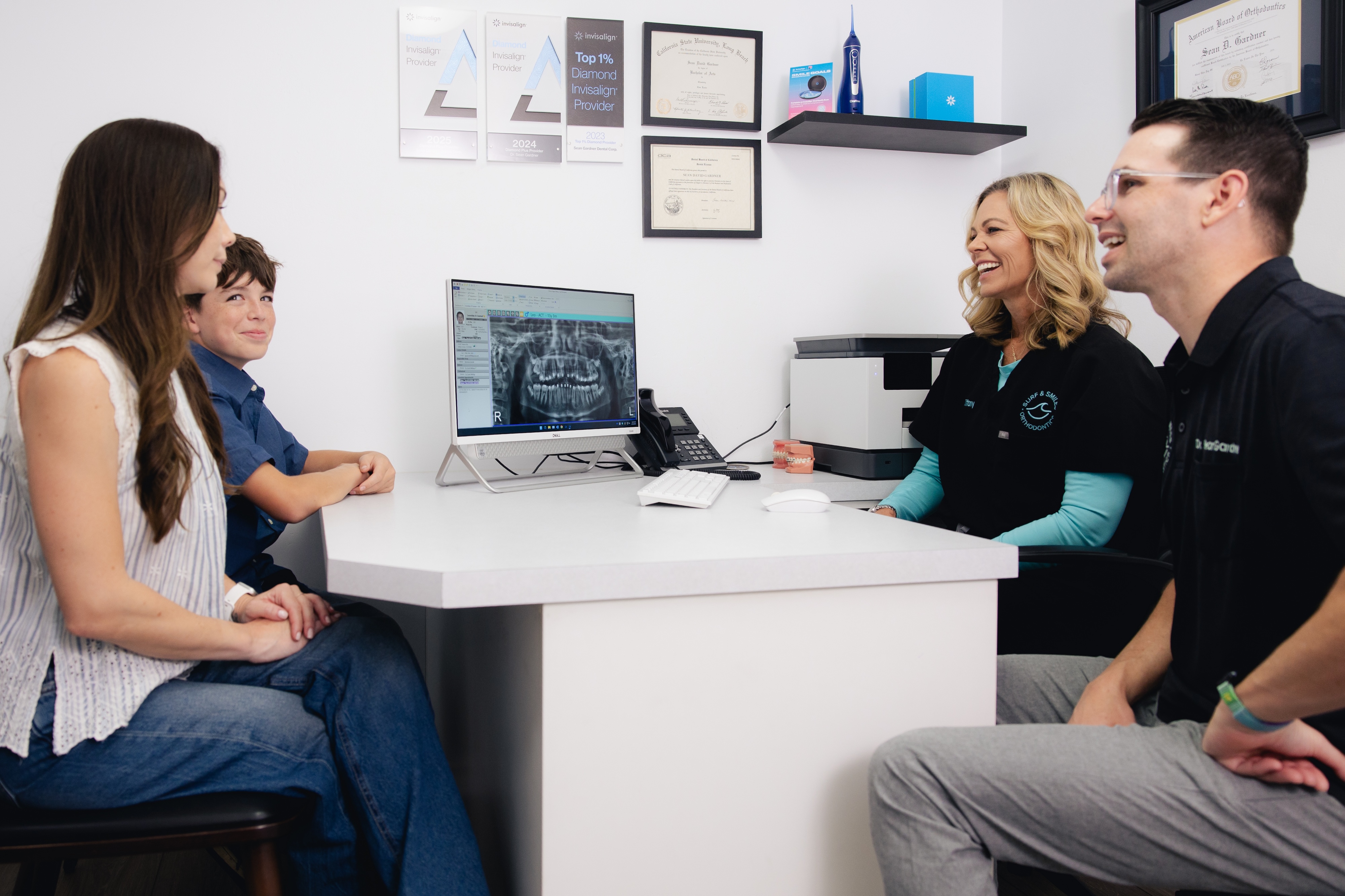
A first consultation can feel like a big unknown, especially if you're not sure whether you'll be examined, quoted, or pitched. Knowing the shape of the visit takes a lot of the pressure off. At our Vista and Fallbrook offices, most first appointments follow a similar rhythm:
- A clinical exam where Dr. Gardner or Dr. Sullivan looks closely at your teeth, bite, and jaw alignment
- Digital imaging to capture a detailed view of what's happening below the surface
- A treatment discussion covering which options genuinely fit your situation and goals
- A cost overview that spells out the fee, insurance, and payment options in plain terms
The imaging part is worth flagging, because it's where a lot of people expect the dreaded goopy mold to get an impression of your teeth. We use the iTero digital scanner instead, a small handheld wand that gently scans your teeth while the 3D images appear on screen right away. No putty, no gagging, and the process is quick and comfortable, which also means we can plan treatment more precisely.
Think of the rest of this guide as your prep sheet for that appointment: the questions worth asking, the signals worth reading, and the details worth pinning down before you commit.
Questions to Ask About the Orthodontist's Experience and Credentials
Who moves your teeth matters as much as which treatment you choose. A fair amount of the second-guessing people describe after treatment traces back to one thing: they never really checked who was steering the ship. A few honest questions up front prevent that.
Start simple: "How long have you been treating patients with this?" and "What share of your cases involve the treatment I'm considering?"
A provider who sees a high volume of a given treatment develops real pattern recognition, the tricky bites, the tooth that won't cooperate, the moment a plan needs adjusting. That kind of repetition builds judgment a few cases a year can't. At our Vista and Fallbrook offices, these are exactly the kinds of questions we love answering.
Orthodontist versus general dentist
Not everyone offering aligners is an orthodontist. General dentists can legally provide Invisalign and similar treatments, but an orthodontist has completed an extra two to three years of specialty residency after dental school, focused entirely on moving teeth and correcting bites.
The letters "MS" after a name reflect that graduate-level specialty training. Dr. Gardner's background includes his orthodontic residency at USC and board certification through the American Board of Orthodontics.
Board certification
Board certification goes a step further. A board-certified orthodontist has voluntarily submitted their own cases for review and passed a rigorous exam through the American Board of Orthodontics. It isn't required to practice, which is exactly why it means something. Only about one in three orthodontists earn it, and Dr. Gardner is one of them. It's a credential worth asking about wherever you go.
Don't be dazzled by aligner brand tiers
Those "Diamond" or "Platinum" labels aligner companies hand out? They measure how many cases a provider has run through that company's system. They're volume badges, not skill assessments. A provider can hit a top tier by treating a lot of simple cases, which tells you nothing about how they handle a complex one. It's a common misunderstanding we hear from patients, so keep it in mind.
Questions to Ask About Your Specific Treatment Plan
When a provider says "here's what I recommend," that's the beginning of your research, not the end. A recommendation is an opening for a conversation. The people who feel most settled going into treatment are the ones who asked real questions first. At our Vista and Fallbrook offices, we welcome every question and want you to feel good about moving forward.
Begin with the "why." Ask what, specifically, about your case is driving the recommendation. Why braces over aligners, or the reverse? Why this sequence? A provider who knows your case should be able to explain their thinking in everyday words, not just hand over a plan and a payment form.
From there, a few other questions are worth asking:
- What happens if my case turns out more complex than expected partway through?
- Will I see the same orthodontist each visit, or rotate through different people?
- Who is responsible for overseeing my care and making the call when something needs adjusting?
- What does monitoring look like between appointments?
That continuity question matters more than people expect. It's not uncommon for someone to chose a cheaper aligner option, then discover their provider had limited hands-on experience and wasn't tracking progress closely.
Ask openly who's watching your case, and how often. With a dedicated orthodontic practice, your care stays focused and consistent from the first visit through your final aligner or last wire check.
Questions to Ask About Treatment Timeline
Nobody wants to plan life around a 6-month estimate and end up 18 months deep.
Timelines genuinely vary, and any provider who gives you a single confident number with no context is usually handing you the best case, not the likely one. The honest providers give ranges, not guarantees, and that's the standard worth holding any provider to.
Ask these out loud:
- What's the realistic range for my case, not just the best-case number?
- What could push treatment longer than projected?
- How much does compliance affect the timeline, especially with aligners that need consistent wear?
- If my case runs long, is there extra cost, or is that built in?
Two big drivers shape how long you're in treatment: how complex your case is, and how closely you follow instructions. Wearing aligners the recommended hours, keeping appointments, and staying on top of check-ins all move things along. A provider who's upfront about that instead of promising a tidy number is one worth trusting.
Questions to Ask About Fees, Payment Plans, and Insurance
Cost sits near the top of most people's minds walking in, and rightly so. Orthodontic treatment is a real investment, and you deserve to know exactly what you're paying for before you agree to anything. A practice that's confident in its care will answer every one of these without flinching:
- What does the quoted fee include? Ask whether records, X-rays, and digital scans are bundled in or billed separately.
- Are retainers included? Some practices fold them in; others charge after treatment wraps up.
- What if something breaks or goes missing? A popped bracket or a lost aligner tray, you want the replacement policy in writing.
- Do you work with my insurance, and how does billing work? Ask whether the office files claims for you or leaves reimbursement to you.
- What financing is available? Look for interest-free plans, pay-in-full discounts, and flexible monthly options.
Transparency shouldn't be something you have to pry loose. We keep finances clear from the start, with no hidden fees or surprises, and we walk through every line of what's included so you leave with a real picture. We accept many dental insurance plans and offer a range of payment options, including pay-in-full discounts and interest-free financing, because accessible treatment matters as much as excellent treatment.
If cost has been the thing keeping you from booking, the consultation itself is complimentary. Come in, ask every question above, and get a genuine sense of what treatment would look like with no financial commitment. Call our Fallbrook office at (760) 728-5575 or our Vista office at (760) 724-7887 to schedule yours today.
How to Recognize a High-Pressure Consultation
Once you understand how fees and timelines work, you can spot a visit that's built to close a sale rather than answer your questions.
People share these experiences on orthodontic forums often, and a few patterns come up again and again:
- Same-day-only pricing that expires the moment you leave
- Being rushed through the exam with no room to ask questions
- A treatment recommendation delivered before the exam is even finished
- Vague or dodging answers when you ask directly about experience, process, or cost
None of that is necessarily against the rules, but all of it is worth reading. A consultation built around urgency is usually built around the practice's schedule, not your decision.
A trustworthy visit feels different. You get time to ask questions and clear answers back, the exam happens before any recommendation is made, and walking out without signing never feels like the wrong move — because it isn't. Big decisions deserve breathing room, and a good provider will respect that.
Questions to Ask If You're Seeking Treatment for Your Child or Teen
Choosing a provider for your child is a slightly different job than choosing one for yourself. You're weighing clinical skill, yes, but also whether the team will keep you in the loop, whether they'll be honest when waiting is the smarter move, and whether your kid will feel at ease walking in. A few questions help you sort that out.
When should my child first be evaluated?
The American Association of Orthodontists suggests an initial check around age 7, which surprises plenty of parents. An early evaluation doesn't mean early treatment, though. A good provider will happily tell you that your child just needs monitoring for now if that's the case. If someone jumps straight to a plan without explaining why the timing makes sense, take note.
What is Phase 1 treatment, and does my child actually need it?
Phase 1 is early interceptive treatment, usually somewhere between ages 6 and 10, before all the permanent teeth arrive. It genuinely helps in certain situations, but not every child needs it, and a trustworthy provider will say so plainly rather than recommending it across the board. That kind of honesty is exactly what Dr. Gardner and our team lead with at both our Vista and Fallbrook offices.
A few more worth bringing along:
- How do you keep parents informed, especially with younger kids who may not relay details accurately?
- What does compliance look like for a child or teen, and how do you handle it when they're struggling with it?
- If my child needs braces, how are they placed, and how precise is that process?
- What's the records process like, and is it comfortable for a kid with a strong gag reflex?
On that last one: we skip traditional impressions entirely and use the iTero scanner, so a small wand gently captures your child's teeth with the images showing up on screen right away. It's quick, comfortable, and gag-free. When kids do get braces, we use digital indirect bonding for placement, which improves precision and makes the appointment smoother. The goal is a calm visit where your child feels comfortable and a little proud of the smile taking shape.
Questions to Ask as an Adult Considering Orthodontic Treatment
Plenty of adults hesitate, wondering if they've missed the window or how treatment will fit into a working life. Teeth can move at any age, so the real questions are about how treatment folds into the rest of your life and mouth. Worth asking:
- What are my discreet options? Clear aligners like Invisalign and tooth-colored braces are common choices when you'd rather treatment not announce itself in meetings or photos.
- How does treatment work around my existing dental work? Crowns, bridges, implants, and past fillings can all affect the plan, so ask how your history factors in.
- What's realistic for my case? Adult bone doesn't shift quite like a child's, so timelines can differ. An honest provider will set expectations rather than overpromise.
- Will I need coordination with my regular dentist? Some cases benefit from teamwork, and it's fair to ask how that's handled.
Straightening your teeth as an adult isn't just cosmetic, either; a better-aligned bite can be easier to clean and more comfortable to live with. At both our Vista and Fallbrook offices, we use the iTero digital scanner to create detailed 3D images of your teeth with no messy putty or traditional impressions needed. The point of a good consultation is a plan that respects your schedule, your budget, and the dental work you already have.
What to Ask About Retainers and Life After Treatment
Care doesn't end the day the braces come off. Teeth naturally want to drift back toward where they started, so retention is what keeps your results, well, yours. Ask about it before you commit, not after:
- What's your retention protocol? How long will I wear a retainer full-time, and what does the long-term plan look like?
- What retainer types are available? Removable and fixed (bonded behind the teeth) options each have trade-offs worth understanding.
- How do you help prevent relapse? Consistent wear is the biggest factor, so ask what happens if a retainer wears out or a tooth starts shifting.
- What's the ongoing cost? Are retainers included in the treatment fee, and what does a replacement run if one is lost or broken?
None of this should feel like fine print sprung on you at the finish line. Understanding the retention plan up front means the smile you worked for actually lasts.
What a Good Consultation Actually Looks Like
Pull all of this together and the markers of a genuinely patient-centered consultation are pretty consistent. A good one includes:
- Real time with the orthodontist, not just a coordinator running a script
- A proper clinical exam before anyone floats a treatment plan
- Plain-language explanations, because "Class II malocclusion" means nothing to most of us
- A written breakdown of the plan, timeline, and cost before you leave
- Zero pressure to sign anything that day
That last one carries a lot of weight. A good orthodontist wants you to go home, sit with it, and come back with questions. Feeling rushed or cornered is itself useful information.
At both our Vista and Fallbrook offices, the exam comes before any recommendation, the iTero scan gives you a detailed 3D view of your own teeth to look at while we talk, and the conversation stays anchored to your goals and what fits your life.
Because we're transparent about finances, you'll also get a clear picture of cost with no hidden fees or surprises. You should walk out clear-headed and holding the reins. That's the whole point.
Schedule a Complimentary Consultation at Surf and Smiles Orthodontics
Leaving a consultation informed and in control is exactly what we want for everyone who comes to see us, and the simplest way to get there is to come in.
Your first visit at Surf and Smiles Orthodontics is complimentary: a real conversation with our board-certified orthodontists, a comfortable iTero scan, and honest answers to every question you've been collecting while reading this. Dr. Gardner speaks fluent Spanish, too, if that's easier for your family.
Whether you're weighing Invisalign or traditional braces, we'll walk you through the options that genuinely fit your situation.
We have two locations serving Vista, Fallbrook, and the surrounding North San Diego and Orange County areas:
- Fallbrook: 425 E. Alvarado St., Suite C, Fallbrook, CA 92028 — (760) 728-5575
- Vista: 145 Cedar Road, Suite A, Vista, CA 92083 — (760) 724-7887
When you're ready, we'd love to meet you.
connect
with us
We can’t wait to meet you! Enjoy a Complimentary Consultation. Request an appointment online to set up your first visit. We’ll be in touch soon.