

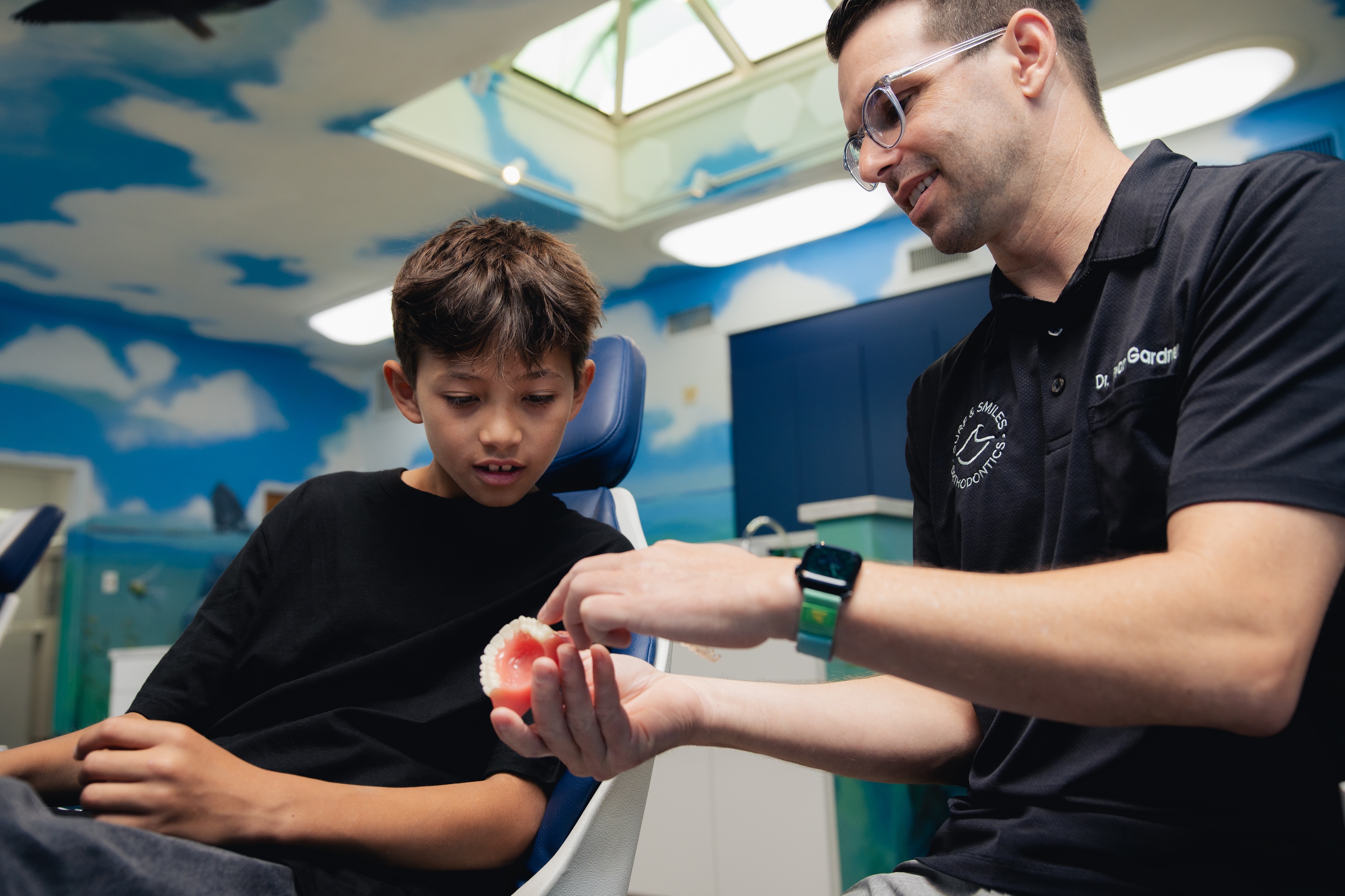
Maybe it was a school photo that caught your eye, or a comment from your family dentist like: "You might want to get an orthodontic opinion on that." Now you're wondering whether crowded front teeth in a second-grader are a real problem or just a phase, and whether booking an orthodontist this early makes you an overly worried parent. or one that's properly concerned.
The official answer is that the American Association of Orthodontists recommends a first orthodontic evaluation by age 7. That's not because most seven-year-olds need braces (they don't). It's because that age gives an orthodontist a clear look at how the bite and jaw are actually developing. Most kids who come in at seven leave with a simple "see you in a year" plan, and that's a fine outcome.
Dr. Gardner and the team at Surf and Smiles Orthodontics see families throughout Vista, Fallbrook, and the surrounding area, and first visits are complimentary. So if you're on the fence, you can get a clear picture of where things stand without any financial pressure. Call our Vista office at (760) 724-7887 or our Fallbrook office at (760) 728-5575 whenever you'd like to set that up.
The short version
- Age 7 is the recommended time for a first orthodontic check, mainly because a mix of baby and permanent teeth gives an orthodontist enough to evaluate.
- Most kids who come in early don't start treatment; they get put on a simple watch-and-check plan.
- A handful of issues (jaw growth, crossbites, certain habits, severe crowding) really do benefit from acting early, before the growth window closes. When braces are the right call, our team uses digital indirect bonding for precise, comfortable placement.
- Plenty of things, like ordinary crowding, are treated more efficiently once all the permanent teeth are in, so waiting is often the smarter call.
- The first visit is an evaluation, not a commitment, and at Surf and Smiles it's free.
Why age 7 is the benchmark, even when nothing looks wrong
Age 7 tends to surprise parents, especially when their child's smile looks perfectly fine. But the recommendation isn't about finding a problem. It's about having enough to look at.
Around this age, most children have a mix of baby teeth and permanent teeth coming in. That mix is exactly what makes the visit useful. It gives an orthodontist a real window into how the jaw is growing, how the bite is shaping up, and whether there's room for the teeth still waiting to arrive. Earlier than this, that information simply isn't there yet.
A first evaluation is just that, an evaluation, not a treatment plan. Here's what an orthodontist is actually looking at:
- Jaw growth, and whether the upper and lower jaws are developing in proportion to each other
- Bite alignment, including crossbites, underbites, or deep bites that tend to worsen if left alone
- Spacing, to gauge whether the incoming permanent teeth will have room to come in properly
For most seven-year-olds, the appointment wraps up with a plan that amounts to "let's keep an eye on it." No braces, no appliances, just periodic check-ins so we can track how things develop. Going early isn't about putting every second-grader in brackets. It's about catching the small number of cases where getting ahead of something genuinely helps. If braces do end up in the picture down the road, our approach uses digital indirect bonding for precise, comfortable placement.
So if part of you feels like scheduling now is overreacting, it isn't. You're just paying attention.
Signs at home worth a closer look
You don't need to play dentist at the kitchen table or memorize a clinical checklist. You just need a sense of what's worth mentioning. Some of these are easy to spot; others are things you might have quietly filed under "that's just how my kid is."
Here are the kinds of things worth flagging sooner rather than later:
- Mouth breathing during the day, or snoring at night
- Thumb-sucking or pacifier use that's carried on past age four or five
- Trouble chewing or biting, or steering clear of certain foods because they're uncomfortable
- Teeth that look very crowded, or gaps that seem unusually wide
- Baby teeth that fell out much earlier or later than you'd expect
- A jaw that shifts to one side, or clicks and pops when your child opens and closes
- Upper and lower teeth that don't seem to line up when they bite down
None of these mean braces are a foregone conclusion. They're simply things an orthodontist is trained to look at more closely than a routine dental cleaning usually allows. If any of this sounds familiar, it's worth bringing up at a complimentary consultation. You're just trusting your gut when something catches your attention, and letting someone with the full picture take it from there.
What early treatment can actually change
Being upfront about timing matters, and that means being clear on when early treatment genuinely helps versus when it's better to hold off. Most kids seen at seven don't need to start anything right away. But there are specific situations where getting ahead of things, before all the permanent teeth arrive, makes a real difference.
Early treatment, sometimes called Phase 1, works best when the goal is guiding jaw growth or heading off something that only gets harder to fix later. The issues that tend to benefit include:
- Jaw growth concerns like an underbite or a narrow upper arch, where the bones are still growing and far more responsive to gentle guidance
- Crossbites that can nudge the jaw off track or wear teeth down unevenly over time
- Habits like thumb-sucking or prolonged pacifier use that are actively shaping how the bite comes in
- Severe crowding, where opening up space early can keep permanent teeth from erupting in the wrong spot entirely
Ordinary crowding, one of the most common reasons families come in worried, is usually handled more efficiently once all the permanent teeth are in. Jumping in too soon can turn one round of treatment into two, and that helps no one.
So an early evaluation with us isn't a hunt for a reason to start. It's a way to figure out whether waiting or acting now actually serves your child better. And when treatment does make sense, our doctors at both Vista and Fallbrook use digital indirect bonding for braces placement, for a more precise, comfortable fit from day one.
What that first visit actually looks like
For a lot of parents, this is where the hesitation lives, not because they don't want answers, but because they're not sure what they're walking into. So here's the plain picture.
A first evaluation is calm and low-key. We take a close look at your child's teeth, bite, and jaw development. There may be some digital X-rays, and the visit also includes a quick scan with our iTero digital scanner. A small handheld wand glides gently over the teeth and builds a detailed 3D image on a screen you can watch in real time. No goopy putty, no gagging, no mess. Honestly, most kids think it's pretty cool.
By the end, you'll have a clear read on where things stand. Families usually leave with one of three outcomes:
- Everything looks great, so we'll see you in about a year for a check-in
- There's something worth watching, and we'll keep an eye on it over the next few visits
- There's an issue that responds well to early action, and we'll walk you through what that would involve
That's the whole thing. You're gathering what you need to make a confident decision, not signing anything on the spot. Because the consultation is complimentary, the only thing you're putting in is a little time.
When treatment does come into the picture down the road, we're always clear about the money side too: no hidden fees, straightforward payment plans, pay-in-full discounts, and interest-free financing, plus we accept many dental insurance plans. And if braces end up being the right path, we use digital indirect bonding for a more precise, comfortable fit. But that's a conversation for whenever the timing is right, not something to worry about at a first look.
When waiting is the right move
Sometimes the most reassuring thing you can hear is, "Your child looks great, let's check back in a year." If you've walked away from a visit like that wondering whether something got missed, take a breath. For a lot of kids, periodic monitoring is exactly the right plan.
Most children don't have all their permanent teeth until somewhere between ages 11 and 13. Starting the full course of treatment before that can mean longer treatment times, more appointments, and occasionally having to revisit things as the mouth keeps changing. Waiting until the full picture is in place often makes treatment more predictable and, in a lot of cases, faster.
Watchful waiting isn't a shrug. It's a deliberate choice that protects your child from treatment they don't need yet while keeping development on the radar. The aim is always the right moment to start. That's why you'll get a straight answer at every visit, whether that answer is "now's the time" or "let's give it another six months."
A few questions parents often ask that are related to this concern
My child is younger than 7. Is it too early to come in?
Not necessarily. Age 7 is a general guideline, not a rule. If you've noticed something on the list above, a mouth-breathing pattern, a jaw that shifts, a habit that won't quit, it's fine to come in sooner. We'll take a look and tell you honestly whether anything needs attention now or can wait.
Will an early visit mean my child ends up in braces?
Usually not. The majority of early evaluations end with a simple monitoring plan. Early treatment is reserved for the specific situations where it clearly helps, and even then, we'll explain exactly why before anything begins.
What if our regular dentist hasn't said anything?
Family dentists do a great job with overall dental health, but an orthodontist looks specifically at growth, bite, and spacing. It's normal for the two to catch different things. Our complimentary consultations are available at both our Vista and Fallbrook locations, and they cost you nothing but a little time.
Come get a clear picture in Vista or Fallbrook
Every kid grows at their own pace, and their teeth and jaws are no different. If you've been going back and forth about whether now's the right time to have someone take a look, a quick evaluation will tell you far more than any article can.
That first visit at Surf and Smiles is complimentary and genuinely relaxed. We'll do the same easy iTero scan we described earlier, then Dr. Gardner will give you a straight answer about where things stand and what, if anything, makes sense next. We'd love to meet your family at either location:
- Vista: 145 Cedar Road, Suite A, Vista, CA 92083 — (760) 724-7887
- Fallbrook: 425 E. Alvarado St., Suite C, Fallbrook, CA 92028 — (760) 728-5575
When you're ready, give us a call and we'll find a time that works for you.
connect
with us
We can’t wait to meet you! Enjoy a Complimentary Consultation. Request an appointment online to set up your first visit. We’ll be in touch soon.